1

Animal Science Intern Jobs in Kansas (NOW HIRING)

Animal Science Intern information

See Kansas salary details

$8

$20

$36

How much do animal science intern jobs pay per hour?

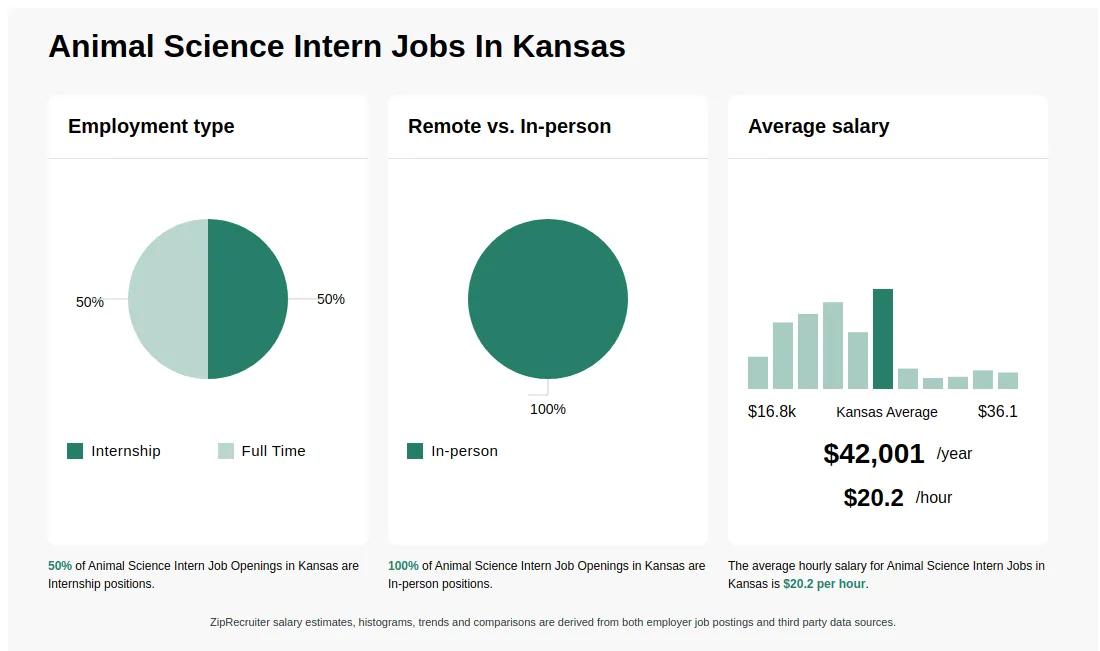
As of Aug 18, 2026, the average hourly pay for animal science intern in Kansas is $20.19, according to ZipRecruiter salary data. Most workers in this role earn between $13.37 and $22.07 per hour, depending on experience, location, and employer.

What does an animal science intern do?

An Animal Science Intern assists with research, animal care, and data collection in various settings such as farms, laboratories, or veterinary clinics. Their duties may include feeding and monitoring animals, maintaining records, and helping with experiments or studies related to animal health and behavior. This hands-on experience helps interns apply classroom knowledge to real-world situations and prepares them for careers in animal science or related fields.

What does an animal science intern do?

An animal science intern can work in a variety of fields, including animal husbandry, zoology, wildlife research, animal nutrition, biological laboratory research, and veterinary medicine. During an internship, your duties vary, depending on the specialization in which you work. But the purpose of the internship is to gain experience by working alongside animal science professionals. If you work with domestic animals or zoo animals, you assist with cleaning enclosures, feeding animals, documenting behavior, and collecting samples. In a laboratory internship, your responsibilities revolve around collecting, analyzing, and documenting specimens. Many animal science internships require working outdoors for at least part of the program.

What types of projects or research might an animal science intern typically contribute to during their internship?

As an Animal Science Intern, you may be involved in a variety of projects ranging from assisting with animal care protocols and nutrition studies to supporting breeding programs or data collection for ongoing research. Interns often work closely with experienced professionals in laboratory, farm, or field settings, gaining hands-on experience while contributing to the team’s goals. This collaborative environment allows interns to develop practical skills and gain insight into the many career paths within animal science.

What are the key skills and qualifications needed to thrive as an animal science intern, and why are they important?

To thrive as an Animal Science Intern, you need foundational knowledge in animal biology, husbandry, and laboratory or field research, generally acquired through coursework in animal science or a related field. Familiarity with data collection tools, laboratory equipment, and animal management software is often required. Strong observational skills, attention to detail, and effective teamwork set outstanding interns apart. These abilities ensure both animal welfare and accurate data collection, supporting meaningful contributions to research or animal care operations.

What is the difference between Animal Science Intern vs Animal Technician?

AspectAnimal Science InternAnimal Technician
Required CredentialsTypically pursuing or recent graduate of animal science or related degreeHigh school diploma or equivalent; some roles may require certification
Work EnvironmentResearch facilities, farms, or labs; learning-focusedAnimal care facilities, farms, laboratories; hands-on work
Employer & Industry UsageUniversities, research institutions, agricultural companiesVeterinary clinics, farms, animal shelters
Common Search & Comparison IntentEntry-level, learning roles in animal sciencePractical animal care and management roles

The main difference is that Animal Science Interns are typically students or recent graduates gaining experience in research or academic settings, while Animal Technicians are more hands-on professionals responsible for daily animal care and management. Interns focus on learning and observation, whereas technicians perform routine animal handling and maintenance tasks.

What are the most commonly searched types of Animal Science jobs in Kansas?

The most popular types of Animal Science jobs in Kansas are:

What are popular job titles related to Animal Science Intern jobs in Kansas?

For Animal Science Intern jobs in Kansas, the most frequently searched job titles are:

What cities in Kansas are hiring for Animal Science Intern jobs?

Cities in Kansas with the most Animal Science Intern job openings:

Infographic showing various Animal Science Intern job openings in Kansas as of August 2026, with employment types broken down into 1% As Needed, 75% Full Time, 20% Part Time, 1% Temporary, and 3% Contract. Highlights an 73% Physical, 4% Hybrid, and 23% Remote job distribution, with an average salary of $42,001 per year, or $20.2 per hour.

Supervisory General Engineer

Work With Us : USDA ARS

Manhattan, KS • On-site

$147K/yr

Full-time

Posted 4 days ago


Job description

This position is located at the United States Department of Agriculture (USDA), Agricultural Research Services (ARS), National Bio And Agro-Defense Facility located in Manhattan, KS.
In this position, you will provide leadership and technical direction in formulating and executing programs and policies related specifically to the NBAF Facility as NBAF Director of Operations.Qualifications:Applicants must meet all qualifications and eligibility requirements by the closing date of the announcement including specialized experience and/or education, as defined below.
Basic Qualification Requirements:
Degree: Engineering. To be acceptable, the program must: (1) lead to a bachelor's degree in a school of engineering with at least one program accredited by ABET; or (2) include differential and integral calculus and courses (more advanced than first-year physics and chemistry) in five of the following seven areas of engineering science or physics: (a) statics, dynamics; (b) strength of materials (stress strain relationships); (c) fluid mechanics, hydraulics; (d) thermodynamics; (e) electrical fields and circuits; (f) nature and properties of materials (relating particle and aggregate structure to properties); and (g) any other comparable area of fundamental engineering science or physics, such as optics, heat transfer, soil mechanics, or electronics.
OR
Combination of education and experience: college-level education, training, and/or technical experience that furnished (1) a thorough knowledge of the physical and mathematical sciences underlying engineering, and (2) a good understanding, both theoretical and practical, of the engineering sciences and techniques and their applications to one of the branches of engineering. The adequacy of such background must be demonstrated by one of the following:
  1. Professional registration or licensure -- Current registration as an Engineer Intern (EI), Engineer in Training (EIT)1 , or licensure as a Professional Engineer (PE) by any State, the District of Columbia, Guam, or Puerto Rico. Absent other means of qualifying under this standard, those applicants who achieved such registration by means other than written test (e.g., State grandfather or eminence provisions) are eligible only for positions that are within or closely related to the specialty field of their registration. For example, an applicant who attains registration through a State Board's eminence provision as a manufacturing engineer typically would be rated eligible only for manufacturing engineering positions.
  2. Written Test -- Evidence of having successfully passed the Fundamentals of Engineering (FE)2 examination or any other written test required for professional registration by an engineering licensure board in the various States, the District of Columbia, Guam, and Puerto Rico.
  3. Specified academic courses -- Successful completion of at least 60 semester hours of courses in the physical, mathematical, and engineering sciences and that included the courses specified in the basic requirements under paragraph A. The courses must be fully acceptable toward meeting the requirements of an engineering program as described in paragraph A.
  4. Related curriculum -- Successful completion of a curriculum leading to a bachelor's degree in an appropriate scientific field, e.g., engineering technology, physics, chemistry, architecture, computer science, mathematics, hydrology, or geology, may be accepted in lieu of a bachelor's degree in engineering, provided the applicant has had at least 1 year of professional engineering experience acquired under professional engineering supervision and guidance. Ordinarily there should be either an established plan of intensive training to develop professional engineering competence, or several years of prior professional engineering-type experience, e.g., in interdisciplinary positions. (The above examples of related curricula are not all inclusive.)
In addition to the basic requirements above, all applicants must also meet the following minimum qualification requirements:
GS-15:

Specialized Experience: Specialized experience is experience directly related to the position to be filled. Specialized experience must be described for each grade level advertised. The specialized experience requirements for this position are: Qualifying experience for GS-15 includes one year of specialized experience comparable to GS-14 which is directly related to the work of this position and which has equipped the applicant with the knowledge, skills, and abilities to perform successfully the duties of the position. For this position, specialized experience is experience implementing strategic plans for the management of high containment research facilities and animal housing facilities; leading multidisciplinary teams dedicated to facilities management; and interpreting blueprints and drawings of buildings and associated systems.
Containment Work Requirements
Working in a high containment laboratory poses some degree of risk to human health. For the health and safety of the incumbent and to prevent the spread of diseases, immunization against diseases being studied at NBAF which are transmissible to humans is required where the vaccine has been approved by the Food and Drug Administration (FDA) for safety and effectiveness under the Federal Food, Drug and Cosmetic Act, as amended 21 USC 321-392.
Investigational vaccines are those approved for human testing while they continue gathering additional safety and efficacy data in advance of full approval for commercial release. While immunization with FDA investigational vaccines is strongly encouraged, the incumbent will be advised that such immunization is voluntary.
Individuals who are already vaccinated or do not wish to receive the investigational vaccines will be asked to sign a declination form, assuming the risk of working with the viruses without vaccination.
Ongoing Health Status Monitoring
Psychological and physical health are monitored as part of a person review. For physical health monitoring, a baseline blood sample will be required for employees entering and working in the biocontainment facility. When enrolled in the serum monitoring program, in addition to physical and psychological examinations, the physical health status of personnel is monitored periodically using biologic and serological tests. Beyond regular monitoring programs, blood draws will be needed to monitor the specific medical surveillance examinations.
Any medical condition which could create an unsafe environment for the individual or his/her co workers, such as: Insufficient control of a medical disorder which could result in sudden loss of consciousness; and inadequate vision and hearing required for safety in a laboratory environment must be considered before a job offer and may be disqualifying.
Decontamination/Body Requirements
The incumbent must have the ability to take a full-body shower with soap and shampoo one or more times per day without assistance. The incumbent must not have a skin condition which would prevent daily showering. Jewelry of any kind is not permitted inside containment.
Body jewelry in piercings must have the ability to be removed prior to entering biocontainment or the piercing and jewelry must be completely sealed off from the working environment to protect the individual from contamination. No unhealed piercings are permitted inside biocontainment.
External medical devices may not be permitted. External medical devices must have the ability to be removed prior to entering biocontainment or be sealed off from the working environment to protect the individual from contamination. Facial hair restriction are required to ensure the proper fit of tight-fitting respirators.
Experience refers to paid and unpaid experience, including volunteer work done through National Service programs (e.g., Peace Corps, AmeriCorps) and other organizations (e.g., professional; philanthropic; religious; spiritual; community, student, social). Volunteer work helps build critical competencies and can provide valuable training and experience that translates directly to paid employment. You will receive credit for all qualifying experience, including volunteer experience.Education:Please see above for education qualification requirement information.
Continued Work Requirements
Personal Protective Equipment

Risk is reduced but cannot be eliminated with special safety precautions. Use of Safety protocols and use of Personal Protective Equipment (PPE), such as respirators, disposable personal protective clothing, and eye protection, are used as needed. PPE is dependent upon the work performed and the laboratory space in which the work is performed.
The incumbent is required to wear tight-fitting respirator when working in biological control areas; facial hair restrictions are to comply with proper operation of personal protective equipment. Approval to use a respirator requires a medical evaluation and fit test.Employment Type: OTHER