1

Animal Health Technician Jobs (NOW HIRING)

Be Seen First

The Seasonal Animal Health Technician plays a vital role within an animal shelter, providing essential care, health monitoring, and support services to ensure the wellbeing of shelter animals. This ...

Animal Health Technician

Mesa, AZ · On-site

$21 - $27/hr

As an Animal Health Technician, you will assist in providing appropriate medical and preventive treatments and assist our veterinarians in performing various surgical procedures. This position ...

As an Animal Health Technician, you will help provide proper medical and preventative treatments and assist our veterinarians in performing various surgical procedures. This position requires the ...

... technician/assistant in a shelter/animal hospital setting One (1) year of customer service and professional communication experience Knowledge of animal health and well-being, including nutritional ...

ANIMAL HEALTH TECHNICIAN I The University of Alabama at Birmingham General Responsibilities: The Animal Health Technician 1 is an entry-level health technician position that primarily focus is to ...

ANIMAL HEALTH TECHNICIAN I

Tampa, FL · On-site

$15 - $24.40/hr

ANIMAL HEALTH TECHNICIAN I The University of Alabama at Birmingham General Responsibilities: The Animal Health Technician 1 is an entry-level health technician position that primarily focus is to ...

ANIMAL HEALTH TECHNICIAN I

Tampa, FL · On-site

$15 - $24.40/hr

ANIMAL HEALTH TECHNICIAN I The University of Alabama at Birmingham General Responsibilities : To assist in routine veterinary care of laboratory animals at UAB. To provide research and technical ...

ANIMAL HEALTH TECHNICIAN I The University of Alabama at Birmingham General Responsibilities : To assist in routine veterinary care of laboratory animals at UAB. To provide research and technical ...

next page

Showing results 1-20

Animal Health Technician information

See salary details

$29.5K

$48.6K

$63.5K

How much do animal health technician jobs pay per year?

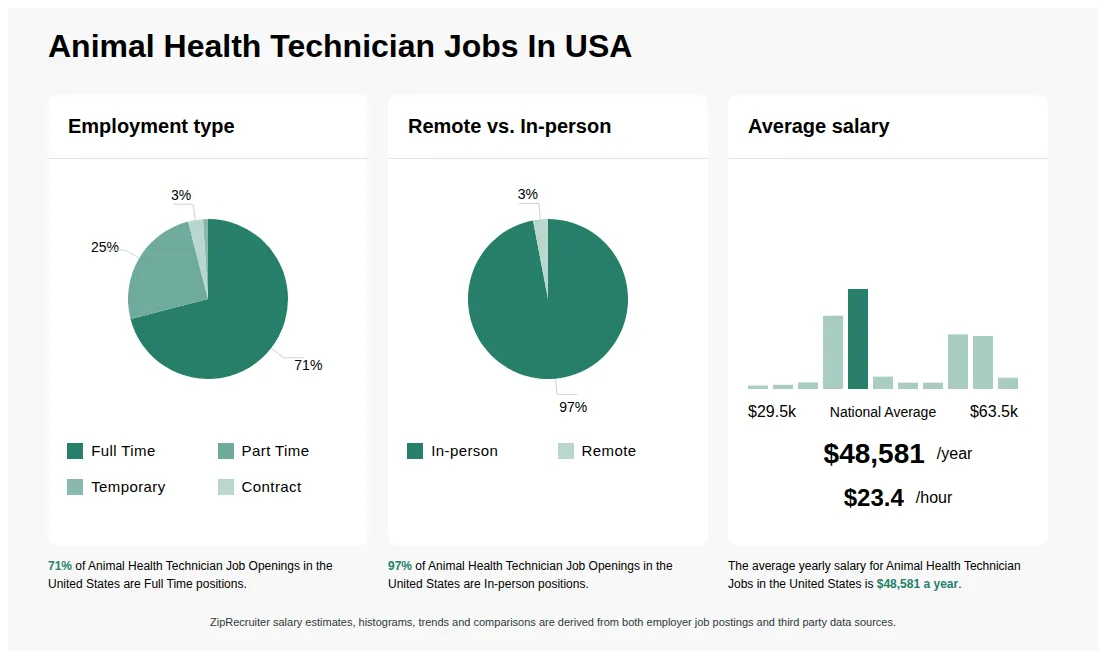
As of Sep 2, 2026, the average yearly pay for animal health technician in the United States is $48,581.00, according to ZipRecruiter salary data. Most workers in this role earn between $42,000.00 and $57,000.00 per year, depending on experience, location, and employer.

What is an animal health technician?

An animal health technician provides medical care to animals that may be sick or injured. In this career, your job duties include examining animals that are brought into the vet hospital, treating wounds on the animal, and performing preventative veterinary care for the animals. The qualifications needed for a career as an animal health technician include a bachelor’s degree in veterinary medicine. You also need strong critical thinking skills and experience with animals and pets.

What are the key skills and qualifications needed to thrive as an animal health technician?

To thrive as an Animal Health Technician, you need a solid background in animal biology, veterinary procedures, and laboratory techniques, typically supported by a diploma or associate degree in veterinary technology and certification (such as RVT or CVT). Familiarity with veterinary software, diagnostic equipment, and laboratory testing systems is commonly required. Strong attention to detail, compassion, effective communication, and the ability to work well under pressure are standout soft skills. These abilities ensure accurate patient care, efficient clinic operations, and the wellbeing of both animals and clients.

What are some common challenges animal health technicians face when working in a veterinary clinic setting?

Animal Health Technicians often encounter fast-paced environments where they must juggle multiple tasks, such as assisting veterinarians during procedures, handling stressed or aggressive animals, and communicating with pet owners. Balancing these responsibilities while maintaining accurate medical records and ensuring proper sanitation can be demanding. Developing strong teamwork skills and adaptability helps technicians manage these challenges effectively, making the role both rewarding and dynamic.

What is the difference between Animal Health Technician vs Veterinary Technician?

AspectAnimal Health TechnicianVeterinary Technician
CredentialsTypically requires a diploma or certification in animal health technologyRequires graduation from an accredited veterinary technology program and certification
Work EnvironmentAnimal shelters, zoos, research labs, farmsVeterinary clinics, animal hospitals, clinics
Employer & IndustryAnimal care facilities, research institutions, farmsVeterinary practices, animal hospitals

Animal Health Technicians and Veterinary Technicians share similar roles in animal care, but Veterinary Technicians usually have more formal education and certification, working primarily in veterinary clinics. Animal Health Technicians often work in broader animal care settings like shelters or farms. Both roles are vital in animal health but differ in training and work environments.

What degree do you need to be an animal health technician?

Animal health technicians typically need an associate degree in veterinary technology or a related field from an accredited program. Certification or licensing may be required depending on the state or employer, and hands-on experience with animals is also important.

What cities are hiring for Animal Health Technician jobs?

Cities with the most Animal Health Technician job openings:

What are the most commonly searched types of Animal Health Technician jobs?

The most popular types of Animal Health Technician jobs are:

What states have the most Animal Health Technician jobs?

States with the most job openings for Animal Health Technician jobs include:

What are popular job titles related to Animal Health Technician jobs?

For Animal Health Technician jobs, the most frequently searched job titles are:

Infographic showing various Animal Health Technician job openings in the United States as of August 2026, with employment types broken down into 1% As Needed, 77% Full Time, 17% Part Time, and 5% Contract. Highlights an 95% Physical, 1% Hybrid, and 4% Remote job distribution, with an average salary of $48,581 per year, or $23.4 per hour.

Animal Health Technician

Morehouse School of Medicine

Atlanta, GA • On-site

$40K - $54K/yr

Full-time

Re-posted 12 days ago


Job description

Posting Details
Position Information
About MSM
Morehouse School of Medicine (MSM) is a place of distinction, serving as the nation's leading academic medical center for vulnerable populations. It's also a place for passionate individuals looking to join a dedicated community working today to help prepare tomorrow's leaders.
We exist to:
• Improve the health and well-being of individuals and communities;
• Increase the diversity of the health professional and scientific workforce;
• Address primary health care through programs in education, research and service;
With emphasis on people of color and the under-served urban and rural populations in Georgia, the nation and the world.
At Morehouse School of Medicine, we're leading the creation and advancement of health equity. You will find a fulfilling career at MSM!
Posting Number
NONAC3765
Job Title
Animal Health Technician
Position Title
Animal Health Technician
Position Type
Non-Faculty
Number of vacancies
1
Salary
Commensurate with experience
Department
CLAR
Position Summary
Job Summary
The Animal Health Technician provides technical animal care and veterinary support to ensure the health, welfare, and humane treatment of laboratory animals used in biomedical research and teaching. Working under the direction of the Attending Veterinarian and Animal Resources leadership, the position performs routine health observations, assists with veterinary procedures, administer treatments, maintains animal health records, and supports regulatory compliance. The Animal Health Technician partners with researchers and animal care staff to maintain high standards of animal welfare while supporting the institution's research mission.
Key Responsibilities
• Provide daily care for laboratory animals, including feeding, watering, housing, environmental monitoring, sanitation, and species-appropriate enrichment.
• Conduct routine health and behavioral observations, recognize signs of illness, injury, pain, or distress, and promptly report concerns to veterinary staff.
• Safely handle, restrain, identify, weigh, and transport animals in accordance with approved procedures and animal welfare standards.
• Administer medications, vaccinations, treatments, and routine health procedures under the direction of veterinary staff.
• Assist with physical examinations, diagnostic testing, disease surveillance, sentinel health monitoring, and the collection of biological specimens, including blood, tissue, urine, and fecal samples.
• Prepare animals, equipment, and procedure areas for medical and surgical procedures; assist with anesthesia induction and monitoring, perioperative care, recovery, and post-operative observation under veterinary supervision.
• Maintain accurate and timely records of animal health observations, treatments, medications, controlled substances, procedures, and research-related activities.
• Clean and disinfect animal housing areas, laboratory equipment, procedure rooms, and surgical spaces in accordance with sanitation and biosecurity requirements.
• Support emergency response and critical animal care activities as directed by veterinary or facility leadership.
• Provide guidance to research personnel on appropriate animal handling, care practices, procedural support, and animal welfare requirements.
• Perform all duties in compliance with approved research protocols, institutional policies, IACUC requirements, USDA regulations, AAALAC standards, and other applicable animal welfare guidelines.
• Assist with regulatory inspections, accreditation reviews, and corrective action activities related to animal care and facility operations.
Knowledge, Skills, and Abilities
• Knowledge of laboratory animal husbandry and animal welfare principles.
• Ability to safely handle and restrain laboratory animal species.
• Basic understanding of veterinary technical procedures.
• Strong observation and documentation skills.
• Ability to work effectively in a regulated research environment.
Minimum Qualifications
Minimum Qualifications:
Education: Associate degree in Veterinary Technology, Animal Science, Biology, or a related life science field; or an equivalent
combination of education and relevant experience.
Education:
• Bachelor's degree in animal science, Biology, Veterinary Technology, or related field.
• Certification by the American Association for Laboratory Animal Science (AALAS), such as Assistant Laboratory Animal
Technician (ALAT) or Laboratory Animal Technician (LAT), or ability to obtain certification within a specified period.
Experience:
• One to three years of experience providing animal care in a laboratory animal, veterinary, agricultural, or research
environment.
• Experience handling common laboratory animal species (rodents preferred).
• Working knowledge of animal husbandry, animal health monitoring, sanitation, and biosecurity practices.
Preferred Qualifications
Preferred Qualifications:
• Prior experience working in an AAALAC-accredited research facility.
• Familiarity with USDA Animal Welfare Act, Public Health Service Policy, Guide for the Care and Use of Laboratory Animals,
and IACUC requirements.
Closing Date
11/20/2026
Open Until Filled
No
Special Instructions to Applicants
Employment in this role may be contingent upon extramural funding and successful performance and may be terminated or reduced in percentage of appointment if such funding is not secured or ceases to be available.
Quick Link
https://careers.msm.edu/postings/24409
EEO Statement Summary
Morehouse School of Medicine is an equal opportunity/equal access/affirmative action employer fully committed to achieving a diverse workforce and complies with all Federal and Georgia State laws, regulations, and executive orders regarding non-discrimination and affirmative action. Morehouse School of Medicine does not discriminate on the basis of race, age, color, religion, national origin or ancestry, sex, gender, disability, veteran status, genetic information, sexual orientation, or gender identity or expression.
Job Duties