
1

Air Weapons Controller Jobs (NOW HIRING)

AIR TRAFFIC CONTROLLER Commercial airlines aren't the only ones who need traffic management. In the ... Operating tactical weapons, sensors, and communications equipment * Working with Pilots to operate ...

AIR TRAFFIC CONTROLLER Commercial airlines aren't the only ones who need traffic management. In the ... Operating tactical weapons, sensors, and communications equipment * Working with Pilots to operate ...

AIR TRAFFIC CONTROLLER Commercial airlines aren't the only ones who need traffic management. In the ... Operating tactical weapons, sensors, and communications equipment * Working with Pilots to operate ...

AIR TRAFFIC CONTROLLER Commercial airlines aren't the only ones who need traffic management. In the ... Operating tactical weapons, sensors, and communications equipment * Working with Pilots to operate ...

AIR TRAFFIC CONTROLLER Commercial airlines aren't the only ones who need traffic management. In the ... Operating tactical weapons, sensors, and communications equipment * Working with Pilots to operate ...

AIR TRAFFIC CONTROLLER Commercial airlines aren't the only ones who need traffic management. In the ... Operating tactical weapons, sensors, and communications equipment * Working with Pilots to operate ...

AIR TRAFFIC CONTROLLER Commercial airlines aren't the only ones who need traffic management. In the ... Operating tactical weapons, sensors, and communications equipment * Working with Pilots to operate ...

AIR TRAFFIC CONTROLLER Commercial airlines aren't the only ones who need traffic management. In the ... Operating tactical weapons, sensors, and communications equipment * Working with Pilots to operate ...

AIR TRAFFIC CONTROLLER Commercial airlines aren't the only ones who need traffic management. In the ... Operating tactical weapons, sensors, and communications equipment * Working with Pilots to operate ...

AIR TRAFFIC CONTROLLER Commercial airlines aren't the only ones who need traffic management. In the ... Operating tactical weapons, sensors, and communications equipment * Working with Pilots to operate ...

AIR TRAFFIC CONTROLLER Commercial airlines aren't the only ones who need traffic management. In the ... Operating tactical weapons, sensors, and communications equipment * Working with Pilots to operate ...

AIR TRAFFIC CONTROLLER Commercial airlines aren't the only ones who need traffic management. In the ... Operating tactical weapons, sensors, and communications equipment * Working with Pilots to operate ...

AIR TRAFFIC CONTROLLER Commercial airlines aren't the only ones who need traffic management. In the ... Operating tactical weapons, sensors, and communications equipment * Working with Pilots to operate ...

AIR TRAFFIC CONTROLLER Commercial airlines aren't the only ones who need traffic management. In the ... Operating tactical weapons, sensors, and communications equipment * Working with Pilots to operate ...

AIR TRAFFIC CONTROLLER Commercial airlines aren't the only ones who need traffic management. In the ... Operating tactical weapons, sensors, and communications equipment * Working with Pilots to operate ...

AIR TRAFFIC CONTROLLER Commercial airlines aren't the only ones who need traffic management. In the ... Operating tactical weapons, sensors, and communications equipment * Working with Pilots to operate ...

AIR TRAFFIC CONTROLLER Commercial airlines aren't the only ones who need traffic management. In the ... Operating tactical weapons, sensors, and communications equipment * Working with Pilots to operate ...

AIR TRAFFIC CONTROLLER Commercial airlines aren't the only ones who need traffic management. In the ... Operating tactical weapons, sensors, and communications equipment * Working with Pilots to operate ...

AIR TRAFFIC CONTROLLER Commercial airlines aren't the only ones who need traffic management. In the ... Operating tactical weapons, sensors, and communications equipment * Working with Pilots to operate ...

AIR TRAFFIC CONTROLLER Commercial airlines aren't the only ones who need traffic management. In the ... Operating tactical weapons, sensors, and communications equipment * Working with Pilots to operate ...

next page

Showing results 1-20

Air Weapons Controller information

See salary details

$55K

$119.5K

$175.5K

How much do air weapons controller jobs pay per year?

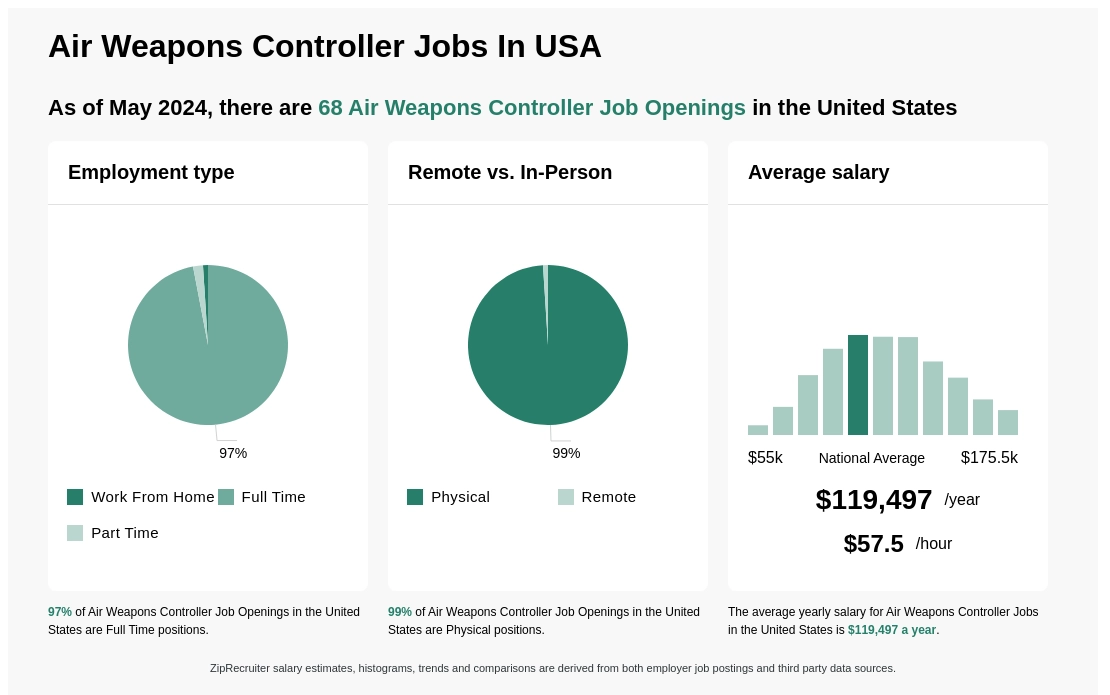
As of Jun 25, 2026, the average yearly pay for air weapons controller in the United States is $119,497.00, according to ZipRecruiter salary data. Most workers in this role earn between $97,000.00 and $138,500.00 per year, depending on experience, location, and employer.

What are some common challenges faced by Air Weapons Controllers during live operations?

Air Weapons Controllers often work in high-pressure environments where they must make quick, accurate decisions to ensure mission success and safety. A major challenge is maintaining situational awareness while managing multiple aircraft and rapidly changing scenarios. Controllers must also coordinate closely with pilots, command staff, and other team members, often under strict time constraints. Adapting to new technologies and evolving tactics is essential, and ongoing training is a key part of staying effective in this dynamic role.

How much do Air Intercept controllers make?

Air Weapons Controllers, including Air Intercept controllers, typically earn between $50,000 and $80,000 annually, depending on experience, rank, and location. Advanced certifications and operational experience can lead to higher salaries within military or civilian defense sectors.

Do air traffic controllers make 300k?

Air Weapons Controllers, a specialized role within air traffic control, typically do not earn salaries as high as $300,000. Most air traffic controllers in the military or civilian sectors earn between $60,000 and $150,000 annually, with higher salaries possible for experienced or supervisory personnel, but reaching $300,000 is uncommon without additional allowances or overtime.

What are Air Weapons Controllers?

Air Weapons Controllers are military personnel responsible for managing and directing the movement of aircraft during combat and training missions. They use radar and communication systems to monitor airspace, provide tactical information, and guide fighter jets or other aircraft to their targets or defensive positions. Their primary goal is to ensure the safety and effectiveness of air operations, often working as part of an air defense team. This role requires quick decision-making, strong communication skills, and the ability to operate advanced technology under pressure.

Is it hard to get hired as an air traffic controller?

Becoming an air weapons controller, a specialized role within air traffic control, typically requires passing rigorous training, obtaining relevant certifications, and demonstrating strong decision-making skills. The hiring process is competitive and involves written exams, psychological assessments, and on-the-job training, making it a challenging career to enter.

What are the key skills and qualifications needed to thrive as an Air Weapons Controller, and why are they important?

To thrive as an Air Weapons Controller, you need strong situational awareness, rapid decision-making abilities, and a background in air defense or military operations, typically supported by specialized training and security clearance. Proficiency in radar systems, command and control software, and communications equipment is essential for effective mission execution. Exceptional communication, stress management, and teamwork skills help controllers coordinate complex operations and respond under pressure. These competencies are crucial for ensuring airspace security, mission success, and the safety of friendly forces.

What do air controllers get paid?

Air Weapons Controllers typically earn between $50,000 and $80,000 annually, depending on experience, location, and level of certification. Salaries can increase with additional responsibilities, specialized skills, and overtime shifts in military or civilian sectors.
Infographic showing various Air Weapons Controller job openings in the United States as of June 2026, with employment types broken down into 91% Full Time, 7% Part Time, 1% Temporary, and 1% Nights. Highlights an 100% Physical job distribution, with an average salary of $119,497 per year, or $57.5 per hour.
AIR TRAFFIC CONTROLLER

AIR TRAFFIC CONTROLLER

U.S. Navy

Saint Cloud, MN • On-site

Full-time

Medical, Retirement

Posted 3 days ago


United States Navy rating

6.3

Company rating: 6.3 out of 10

Based on 371 frontline employees who took The Breakroom Quiz

38th of 46 rated military and defense


Job description

ABOUT

Act as our eyes and ears in the sky, mapping coasts and ports for Navy intelligence. Gain extensive training in radar, sonar, and air traffic communications. If you feel more at home above the sea than on it, a career in aviation might be for you. Below are some examples of the vast opportunities in this field.

AIR TRAFFIC CONTROLLER

Commercial airlines aren’t the only ones who need traffic management. In the Navy, our fighter jets, helicopters, and reconnaissance aircraft need vigilant Air Traffic Controllers to keep flight decks and airstrips in check. As an AC, you work against moving runways, inclement weather and mechanical issues to get personnel safely to the ground. Navy aircraft are

moving all the time, so it’s your responsibility to organize air traffic and communicate critical information to pilots. With extensive training in radar and air traffic communications, this rate is one of the easiest to translate into a civilian career post−service. As an Air Traffic Controller, you can command the skies.

RESPONSIBILITIES

The successful operation of a flight deck on an aircraft carrier is one of the most complex, high−stakes exercises on the planet. It’s no small task to ensure that each aircraft that leaves the flight deck performs its mission successfully and returns home safely. Navy Air Traffic Controllers are essential in directing the everyday complexities above and below the flight deck.

Their responsibilities include:

  • Providing air traffic control services in air traffic control towers, radar air traffic control facilities, fleet area control and surveillance facilities and air operations ashore and afloat
  • Operating radio communication systems and light signals
  • Performing aircraft tactical duties as a flight engineer, loadmaster and/or reel operator
  • Executing handling duties related to the launch and recovery of Naval aircraft
  • Interpreting data shown on radar screens to plot aircraft positions
  • Operating tactical weapons, sensors, and communications equipment
  • Working with Pilots to operate and control aircraft systems

PAY AND BENEFITS

From the day you start, you’ll receive:

  • Competitive salary
  • Potential to earn a bonus upon enlistment
  • Free health insurance
  • Free housing
  • A retirement plan
  • Paid training

EDUCATION OPPORTUNITIES

  • Navy College Program and Tuition Assistance
  • Post−9/11 GI Bill, up to 100% tuition
  • Professional credentials and certifications
  • College credit hours toward a bachelor’s or associate degree through the American Council on Education

QUALIFICATIONS AND REQUIREMENTS

  • U.S. citizen or equivalent
  • High school graduate or equivalent
  • 17 years of age or older

General qualifications may vary depending upon whether you’re currently serving, whether you’ve served before, or whether you’ve never served before.

WORK ENVIRONMENT

Make the world your home. You may be assigned to sea or shore squadrons on almost any continent. You will have the opportunity to work in a variety of environments—from airborne aircraft to hangars, hangar decks to flight decks and flight lines at air stations and on aircraft carriers.

PART-TIME OPPORTUNITIES

The role above is an Active Duty opportunity in the Navy, however there are part-time roles available in Air Support for the Navy. Serving part−time as a Navy Reserve Sailor, your duties will be carried out during your scheduled drilling and training periods. During monthly drilling, Sailors in the Navy Reserve typically work at a location close to their homes.


What United States Navy employees say

Pay

Benefits

Hours and flexibility

Workplace

Get the full story on Breakroom


US Navy logo

About US Navy

Sourced by ZipRecruiter

Industry

National security, national security and international affairs, public safety statistics centers and offices, guided missile and space vehicle manufacturing and public administration

Company size

10,000+ Employees

Headquarters location

Washington, DC, US

Social media