2

Remote Captioning Jobs (NOW HIRING)

Senior Director, Member Care

New York, NY ยท On-site +1

$140K - $200K/yr

... remote workforce to improve member satisfaction, retention, and business outcomes. What you'll do ... live captioning or using a sign language interpreter, or using specialized equipment. We are ...

Installer/Trainer - Full Time

Tacoma, WA ยท On-site +1

$13.08 - $21.83/hr

Sorenson also provides onsite and remote interpreting services between English and various other ... captioning agent to quickly provide written captions of what callers say on a large, easy-to-read ...

Social Editor (Freelancer)

New York, NY ยท Remote

$23 - $53/hr

Familiarity with generative AI tools for editing, captioning, or effects. * Hands-on experience ... This is a remote role. Hourly rate based on education, experience, and skills level ($23-$53)

next page

Showing results 1-20

Remote Captioning information

See salary details

$19

$34

$50

How much do remote captioning jobs pay per hour?

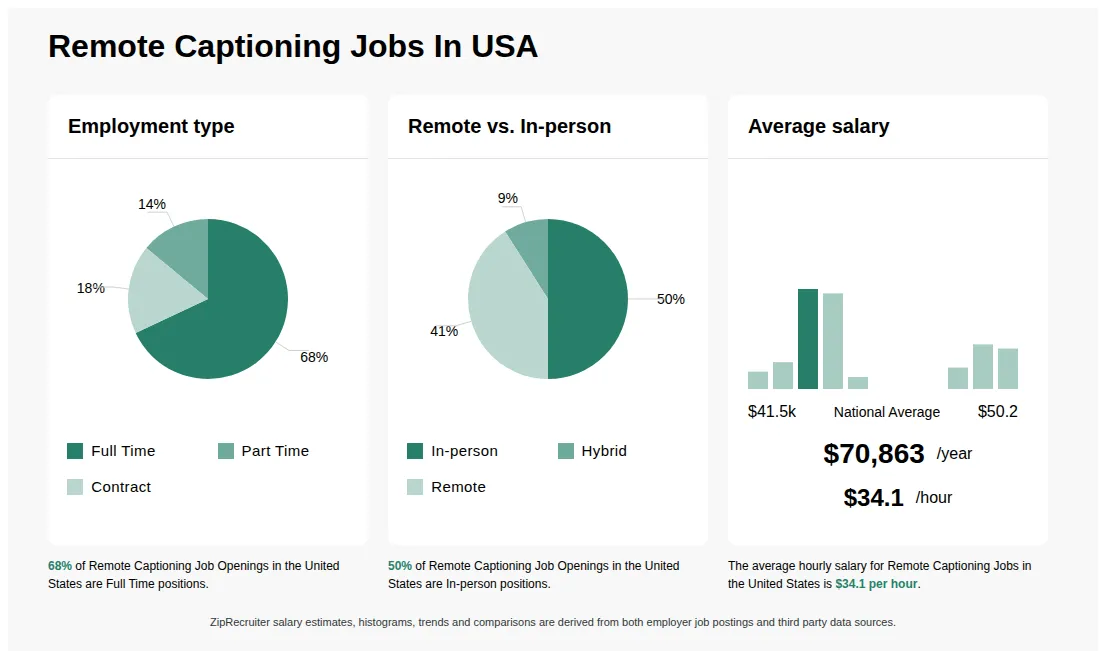
As of Jun 4, 2026, the average hourly pay for remote captioning in the United States is $34.07, according to ZipRecruiter salary data. Most workers in this role earn between $26.92 and $45.67 per hour, depending on experience, location, and employer.

What Are Remote Captioning Jobs?

In remote captioning jobs, you work from home to provide closed captioning services to promote the accessibility of live and recorded events. As a remote captioner or subtitler, you transcribe or subtitle the content and then send your work back to your employer or client. Remote captioning jobs usually involve listening to an audio file or watching a video, then sending your captions back via a web-enabled device. The captions you create may be displayed on event screens, television shows, or through any other method the clients need. Remote captioning jobs may involve working unusual hours, including nights, weekends, and holidays.

What are the key skills and qualifications needed to thrive as a Remote Captioner, and why are they important?

To thrive as a Remote Captioner, you need excellent listening skills, fast and accurate typing abilities, and a strong command of grammar and spelling, often supported by a relevant certification such as Certified CART Provider or Certified Broadcast Captioner. Familiarity with captioning software, real-time transcription tools, and video conferencing platforms is typically required. Attention to detail, time management, and the ability to concentrate for extended periods set top performers apart in this role. These skills are vital to ensure accessibility, accuracy, and timely delivery of captions for diverse audiences.

What are some common challenges faced by remote captioners and how can they be managed?

Remote captioners often face challenges such as maintaining accuracy while keeping up with the pace of live audio, managing background noise, and staying focused during long sessions. To address these, it's important to have a distraction-free workspace, use quality headphones, and take regular short breaks to reduce fatigue. Additionally, familiarizing yourself with industry-specific terminology and using captioning software with built-in shortcuts can greatly enhance efficiency and accuracy.

What is remote captioning?

Remote captioning is the process of transcribing spoken words into text in real time for live events, broadcasts, or meetings, using specialized software and communication tools from a remote location. Captioners listen to the audio feed and type out what is being said, which is then displayed as captions on screens for viewers who are deaf or hard of hearing, or for those who prefer to read along. This job requires excellent listening and typing skills, as well as familiarity with captioning software. Remote captioning enables accessibility without the need for the captioner to be physically present at the event.

What is the difference between Remote Captioning vs Remote Transcription?

AspectRemote CaptioningRemote Transcription
CredentialsTypically requires certification in captioning or related trainingNo specific certification usually required
Work EnvironmentLive or recorded captioning for TV, online videos, or eventsConverting audio recordings into text for documents or records
Industry UsageMedia, education, live events, broadcastingLegal, medical, business, media
Search & Comparison IntentOften compared for live vs. recorded work, or for accessibility rolesCompared for document accuracy, legal or medical transcription

Remote captioning involves providing real-time or recorded captions for media, events, or broadcasts, often requiring specialized certification. Remote transcription focuses on converting audio recordings into written documents, typically without the need for certification. Both roles are essential in media, legal, and medical industries but differ mainly in their output and immediacy.

What cities are hiring for Remote Captioning jobs? Cities with the most Remote Captioning job openings:
What are the most commonly searched types of Captioning jobs? The most popular types of Captioning jobs are:
What states have the most Remote Captioning jobs? States with the most job openings for Remote Captioning jobs include:
Infographic showing various Remote Captioning job openings in the United States as of May 2026, with employment types broken down into 58% Full Time, 26% Part Time, and 16% Contract. Highlights an 100% Remote job distribution, with an average salary of $70,863 per year, or $34.1 per hour.
Image Library Editor (Volunteer)

Image Library Editor (Volunteer)

WhoWhatWhy

Los Angeles, CA โ€ข On-site, Remote

Part-time

Posted 13 days ago


Job description

Image Library Editor (Volunteer)
Note: This is a remote, part-time volunteer position.
Just two or three hours a week can make a real difference.
We're looking for an Image Library Editor to help build, organize, and maintain a library of high-quality visuals that support our journalism. This role is ideal for someone who enjoys working carefully and independently with images, metadata, and digital assets - and wants to contribute to meaningful editorial work without taking on a heavy weekly commitment.
You'll help source, process, and organize images from Creative Commons, the public domain, and other approved sources for use across our stories and projects. Training is provided, and the workload is intentionally manageable.
Who We Are
WhoWhatWhy is an independent nonprofit investigative news organization producing deep-dive journalism on the most important issues of our time. We're powered by skilled volunteers and a small core staff - from students to seasoned professionals - who believe in rigorous, ethical reporting free from corporate or political influence.
About the Role
As an Image Library Editor, you will help build a visual resource that writers, editors, and other team members can draw from in support of strong storytelling. You will:
  • Source images from Creative Commons, public domain, and other approved sources
  • Review and edit selected images for quality, consistency, and usability
  • Organize and catalog images for easy retrieval and future use
  • Add accurate metadata, attribution, and other identifying information
  • Help ensure images are properly documented for editorial use
  • Process approximately 10 images per week
  • Work with the Lead Image Editor to follow established workflows and standards
  • Communicate regularly about progress, questions, and image availability
What We're Looking For
  • Experience editing or preparing digital images using Photoshop or similar tools
  • Strong attention to detail in organizing files, tracking metadata, and maintaining accurate attribution
  • Comfort working carefully and consistently with repetitive but important editorial support tasks
  • Interest in photography, visual storytelling, digital media, or journalism support work
  • Ability to work independently and follow an established workflow
  • Clear written communication and reliable follow-through
Bonus
  • Familiarity with Creative Commons, public domain, or rights-cleared image sourcing
  • Experience working with image libraries, digital asset organization, or content archives
  • Experience writing captions, metadata, or attribution notes
  • Familiarity with Google Docs or other shared digital workspaces
  • Interest in journalism, editorial production, or nonprofit media
Commitment
We value volunteers who can contribute consistently over time and communicate reliably with their teams. Scheduling is flexible and will vary depending on the role, workload, and department needs.
For this role, the expected workload is light - typically around 2-3 hours per week, with approximately 10 images processed per week.
How to Apply
Please send:
  • Your resume or a brief summary of your relevant experience
  • A short note explaining your interest in the role
  • Optional but helpful: a few examples of image editing, photo sourcing, metadata, captioning, or other relevant visual work

If you cannot upload your materials, email them to [email protected]. Please check your spam folder for responses.
Reminder
We value thoughtful, genuine applications that reflect your own voice and interest in the role.