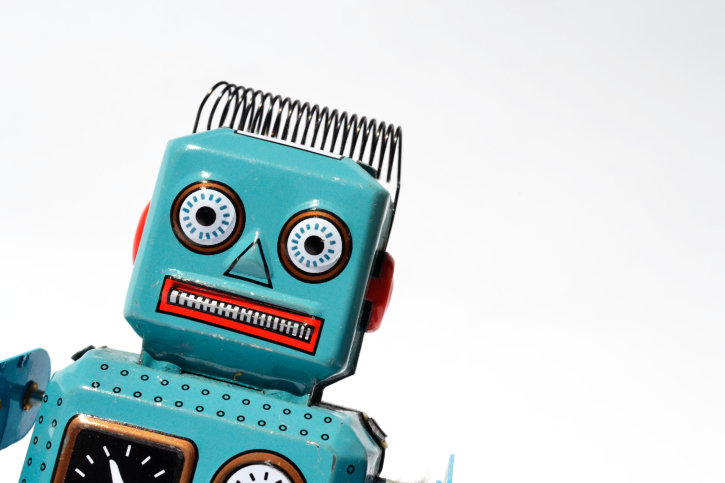
What does a pharmacist, an anesthesiologist, a sports reporter and a farmer have in common? They all have jobs that robots are currently capable of doing. And someday, those jobs may be done exclusively by robots.
If this sounds like something in the science fiction future, then consider this. Amazon has already added more than 15,000 robots to its distribution warehouses. Goods that used to be retrieved and packaged for shipment by humans are now being prepared more quickly and efficiently by robots. Amazon also has big plans to someday use drones to deliver packages to your door in 30 minutes or less.
Robots have long been champions of manufacturing and assembly-line tasks that are tedious, dangerous or labor intensive. Think factory work, where robots excel over humans at things such as speed, precision and efficiency. But as artificial intelligence becomes more sophisticated, the range of things that robots and other “smart systems” can or may someday accomplish is practically limitless.
Ray Kurzweil, the well-known futurist and director of engineering at Google, states that robots will achieve human levels of intelligence by the year 2029. The possibilities and implications of this prediction are a bit mind-boggling. But what does it mean for you personally in the short term?
Gartner, an information technology research and advisory company, predicts that one-third of jobs will be replaced by software, robots, and smart machines by 2025. And in a 2013 report, University of Oxford researchers Carl Benedikt Frey and Michael Osborne estimated that 47 percent of U.S. jobs could be automated or taken over by computers by 2033.
And it’s not just blue-collar jobs that are at stake. White-collar jobs are becoming increasingly vulnerable, particularly jobs that require financial computing, data analysis and research (i.e. accountants, market research analysts, and paralegals).
Even professions that once seemed immune to automation, such as surgeons and diagnosticians, are no longer safe. IBM’s Watson supercomputer, which gained fame after beating some of the world’s top Jeopardy! players, has already shown that it can diagnose cancer better than doctors. Computers have an advantage over human physicians in that they don’t get tired, make careless mistakes or succumb to personal biases or distractions.
So what are the chances that your job might soon be taken over by a machine? For fun, NPR’s radio program Planet Money devised a calculator that can help predict the likelihood that your job will become automated in the next 20 years. But before you start to panic, it’s important to remember that this isn’t necessarily a bad thing. Historically, technology has always been a disruptive force, replacing old paradigms with new ones. The industrial age automated manual labor and freed up human workers to perform higher-level tasks.
Many experts believe that as human powered jobs are taken over by technology, new jobs and opportunities for humans will emerge, as they did during the industrial revolution. The change could allow us to shift our gaze inward, forcing us to focus and redefine our roles as humans.