1

Nasa Human Factors Jobs (NOW HIRING)

As a Human Factors Engineer supporting the NASA Lunar Terrain Vehicle Services (LTVS) within the Extravehicular Activity and Human Surface Mobility Program (EHP), you will champion the human-centered ...

Senior Project Manager (NASA CMC)

Webster, TX ยท On-site

$92K - $166K/yr

Demonstrated experience managing NASA or human spaceflight-related projects * Experience managing ... Additional factors considered in extending an offer include (but are not limited to ...

Senior Project Manager (NASA CMC)

Webster, TX ยท On-site

$92K - $166K/yr

Demonstrated experience managing NASA or human spaceflight-related projects * Experience managing ... Additional factors considered in extending an offer include (but are not limited to ...

Demonstrated experience managing NASA or human spaceflight-related projects * Experience managing ... Additional factors considered in extending an offer include (but are not limited to ...

As a Human Factors Engineer, you will play a pivotal role in the design, development, and ... Experience in workload assessments and situation awareness assessments such as NASA TLX

This posting is for a Senior Systems Engineer to support NASA's Human Exploration Development and ... Actual compensation may vary based on factors such as job responsibilities, education, experience ...

As a Human Factors Engineer, you will play a pivotal role in the design, development, and ... Experience in workload assessments and situation awareness assessments such as NASA TLX

... NASA instructions. * Participate in the Human Systems Integration (HSI) workflow, including ... factors design feedback/concerns from ticket creation through closure; using Figma and other rapid ...

next page

Showing results 1-20

NASA Human Factors information

See salary details

$42K

$89.1K

$147K

How much do nasa human factors jobs pay per year?

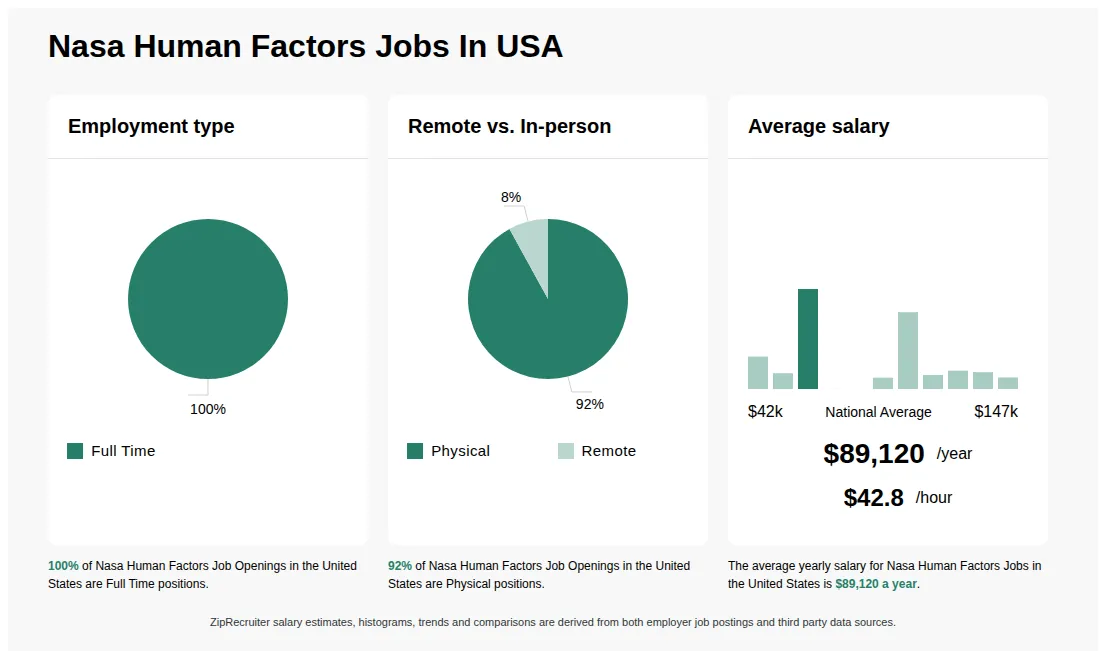
As of Jun 9, 2026, the average yearly pay for nasa human factors in the United States is $89,120.00, according to ZipRecruiter salary data. Most workers in this role earn between $62,500.00 and $107,000.00 per year, depending on experience, location, and employer.

What are the key skills and qualifications needed to thrive in the Nasa Human Factors position, and why are they important?

To thrive as a NASA Human Factors specialist, you generally need a background in human factors engineering, psychology, or a related field, and experience with ergonomic design and human-computer interaction. Familiarity with simulation tools, usability testing platforms, and data analysis software such as MATLAB or SPSS is often required. Strong problem-solving skills, effective communication, and collaboration abilities help candidates stand out in multidisciplinary teams. These skills are vital to ensure that space systems are user-friendly, safe, and optimized for human performance in challenging environments.

What is a NASA Human Factors job?

A NASA Human Factors job focuses on studying and designing systems, equipment, and environments to optimize human performance, safety, and comfort in space and aviation. Specialists in this field apply psychology, engineering, and ergonomics to improve astronaut performance, workspace design, controls, and habitability in spacecraft and mission operations. They work on challenges such as mitigating fatigue, enhancing crew communication, and designing intuitive interfaces. Their work ensures that space missions are safe, efficient, and aligned with human capabilities and limitations.


What are some typical responsibilities of a NASA Human Factors specialist, and how do they impact mission success?

NASA Human Factors specialists are responsible for analyzing and improving the interaction between humans and spacecraft systems, with a focus on safety, comfort, and efficiency. This includes conducting ergonomic assessments, designing user interfaces, performing crew task analyses, and facilitating simulations or user trials. Their work often involves close collaboration with engineers, astronauts, and medical professionals to minimize human error and ensure systems are intuitive and reliable. By providing critical insights into how humans interact with technology in demanding environments, their contributions play a significant role in the success and safety of space missions.

More about NASA Human Factors jobs
What cities are hiring for Nasa Human Factors jobs? Cities with the most Nasa Human Factors job openings:
What are the most commonly searched types of Nasa Human Factors jobs? The most popular types of Nasa Human Factors jobs are:
What states have the most Nasa Human Factors jobs? States with the most job openings for Nasa Human Factors jobs include:
What job categories do people searching Nasa Human Factors jobs look for? The top searched job categories for Nasa Human Factors jobs are:
Infographic showing various Nasa Human Factors job openings in the United States as of May 2026, with employment types broken down into 100% Full Time. Highlights an 100% In-person job distribution, with an average salary of $89,120 per year, or $42.8 per hour.

LTVS Human Factors Engineer (NASA LTVS Contingent)

Astrolab

Hawthorne, CA โ€ข On-site

$100K - $131K/yr

Full-time

Medical, Dental, Vision, Retirement, PTO

Posted 11 hours ago


Job description

LTVS Human Factors Engineer (NASA LTVS Contingent)
Department: Program Management
Employment Type: Full Time
Location: Hawthorne, California
Reporting To: Victor Kitmanyen
Compensation: $100,000 - $131,000 / year
Description
Venturi Astrolab, Inc. (Astrolab) is pioneering new ways to explore and operate on distant planetary bodies. We are singularly focused on designing, building, and operating a fleet of multi-purpose commercial planetary rovers to extend and enhance humanity's presence in the solar system. We are seeking motivated, creative, and exceptional people to join our world-class team.
As a Human Factors Engineer supporting the NASA Lunar Terrain Vehicle Services (LTVS) within the Extravehicular Activity and Human Surface Mobility Program (EHP), you will champion the human-centered design of Astrolab's FLEX-LTV, which will be used by Artemis Crew to traverse and explore the lunar environment. You will work closely with cross-disciplinary teams including Systems Engineering & Integration (SEI), Subsystem Responsible Engineers (REs), Crew Accommodations, User Interface (UI) Designers, Simulation & Training, and Operators/Astronauts to ensure that human safety, performance, and usability are engrained in the LTV design. You will report to the Astrolab Human Systems Integration (HSI) Lead under the Program Management Office (PMO).
*Employment in this role is contingent on Astrolab being selected as a winner of NASA's LTVS program.*
What you'll do:
  • Carry out the HSI Plan across the development lifecycle in support of a safe & efficient user experience (UX) for our astronauts
  • Work with our partners at Axiom Space to align the LTV design to suited crew capabilities & limitations while prioritizing safety, operational effectiveness, and crew time efficiency
  • Collaborate with engineers & designers to optimize for suited crew use of LTV displays, controls, and mechanical interfaces
  • Coordinate cross-disciplinary input & testing of LTV Crew Task Lighting to ensure the necessary visual access of all visual targets according to crew procedures and mission objectives
  • Utilize Figma and other rapid prototyping tools to produce interactive graphical user interface (GUI) wireframes and mockups in alignment with Artemis GUI standards and commonality
  • Conduct human factors engineering analyses and evaluations (e.g., Task Analysis (TA), Human Error Analysis (HEA), Human-in-the-Loop (HITL) Testing, Crew Operational Loads, Risk Assessments, etc.) and process findings for design and/or operational impacts
  • Support simulation & training events with astronauts and representative participants using Astrolab test artifacts located at Odyssey Space Research and the Texas A&M Space Institute
  • Manage, adjudicate, and track the flow of human factors design feedback/concerns from ticket creation through design unit implementation in compliance with human systems requirements
  • Assist SEI efforts in executing the Verification, Validation, & Certification Plan as it pertains to the closure of human systems requirements and total-system human-rating
  • Inform and attend cadenced discussions with NASA to share LTV development progress and review key decisions/changes
  • Update and maintain technical documentation, including contractual HSI deliverables to NASA

What you'll bring:
  • Bachelor's degree in Human Factors, Human-Computer Interaction, Human-Centered Design, Ergonomics, or another relevant field (e.g., Biomechanics, Psychology, Industrial Design)
  • 0-5 years of experience in human factors engineering, human systems integration, and/or UI/UX development including user testing, preferably in human spaceflight or a related industry
  • Familiarity with NASA-STD-3001, MIL-STD-1472, and/or the FAA HF-STD-001
  • Understanding of project management and systems engineering processes, tools, and methodologies
  • Strong problem-solving skills with keen attention to detail
  • Excellent verbal communication, written communication, and negotiation skills
  • Ability to empathize with user needs and elicit valuable user/stakeholder feedback
  • Ability to work effectively in a cross-disciplinary team
  • Ability to organize and balance multiple competing priorities in a fast-paced work environment

Nice to Haves
  • Graduate degree in Human Factors, Human-Computer Interaction, Human-Centered Design, Ergonomics, or another relevant field (e.g., Biomechanics, Psychology, Industrial Design)
  • Experience in space architecture, bioastronautics, aerospace physiology, optical engineering, vehicle cabin/interior development, and/or extreme environment analogs
  • Knowledge of space extravehicular activity (EVA) systems (e.g., pressurized suits, EVA tools)
  • Understanding of design thinking and/or rapid spiral development methodologies

Benefits and Perks
  • Join a team of best-in-class engineers building the foundation of planetary surface exploration
  • Equity ownership in the company
  • Comprehensive health benefits, including medical, dental, vision, and mental health support
  • 401(k) plan with company match
  • Flexible PTO and parental leave
  • Home office set up reimbursement
  • Fully flexible and remote friendly work environment
  • Weekly lunch stipend, plus complimentary snacks and beverages on-site
  • Once a month social hour on-site with food and drinks